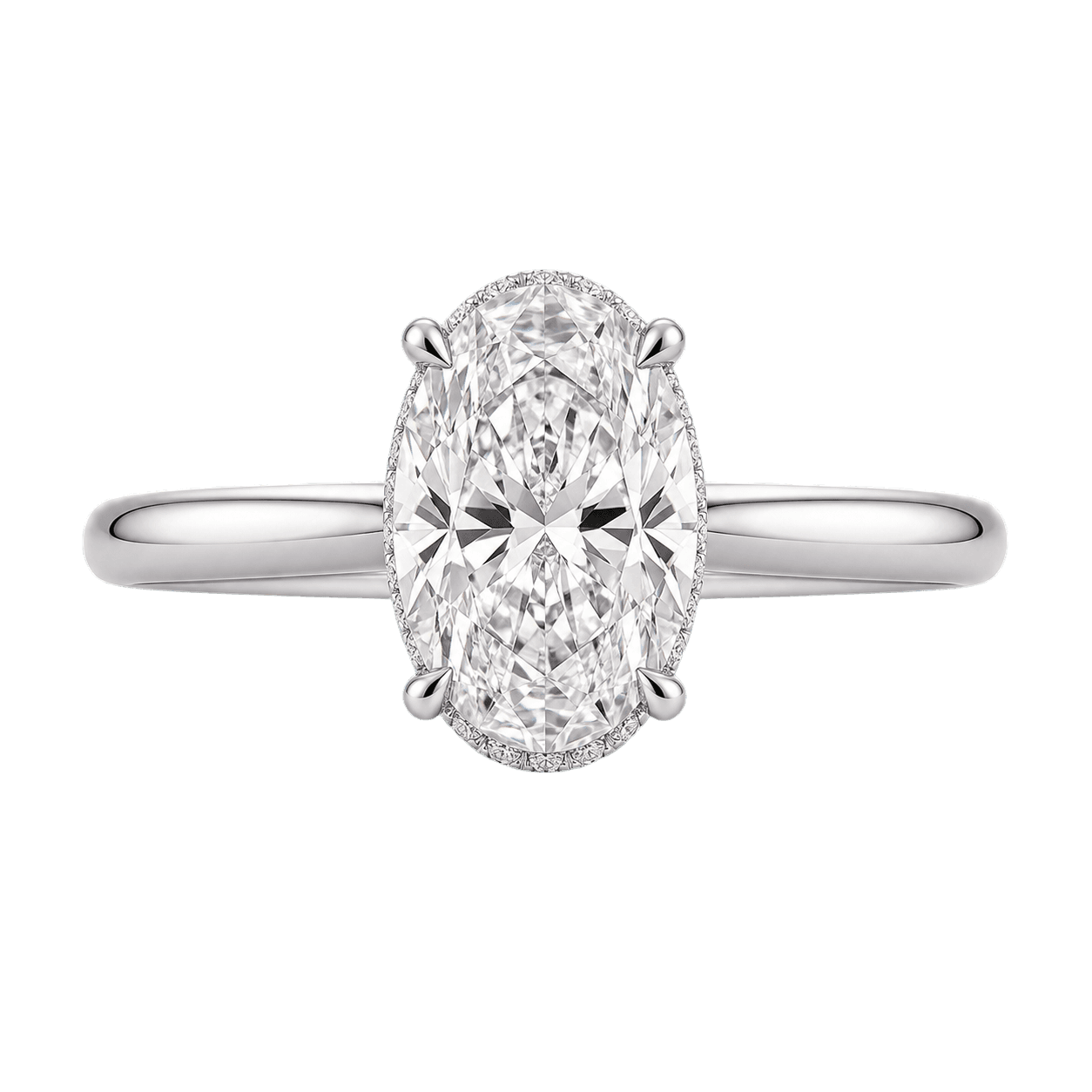
Shape is not the same as cut quality
Shape is the outline you see from above, such as round, oval, or emerald. Cut quality describes how proportions, symmetry, polish, and facet design affect appearance and light performance. Sellers sometimes use ‘cut’ casually to mean shape, so confirm which meaning is intended.
A shape name alone does not guarantee beauty. Two ovals of the same carat weight can have different length-to-width ratios, bow-tie patterns, face-up spread, and symmetry. Compare the actual stone in varied lighting or with clear, neutral video.
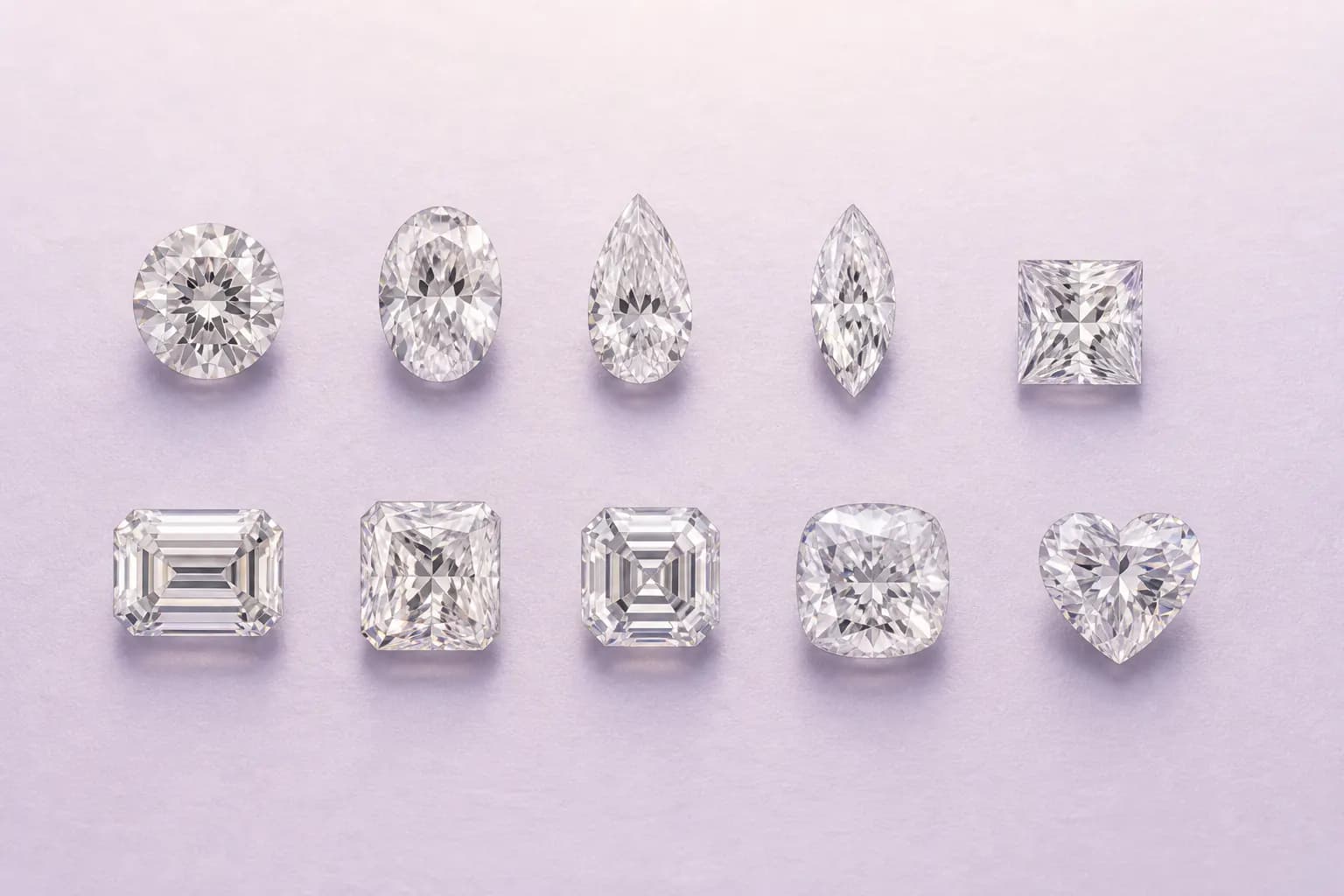
Round: bright, balanced, familiar
Round brilliant diamonds have a symmetrical outline and are the only shape that currently receives an overall GIA cut grade. They work with many setting styles; whether a straight wedding band sits flush depends on the setting profile.
Choose round for a person who values classic balance or lively sparkle. Because demand and cutting yield affect price, compare complete rings rather than assuming a carat-for-carat budget will transfer directly from another shape.
Oval, marquise, and pear: elongated silhouettes
Elongated shapes create a longer line on the finger and can feel soft, dramatic, or directional. Oval is symmetrical and adaptable; marquise is sharper and more theatrical; pear combines a rounded end with a point.
Examine symmetry, outline, and the central light-and-dark pattern often called a bow tie. Pointed ends deserve thoughtful protection, especially for pear and marquise shapes. Length-to-width ratio is a taste choice, not a universal quality grade.
Emerald and Asscher: calm, graphic step cuts
Emerald-cut diamonds use an elongated rectangular outline and broad step facets. Asscher cuts use a squarer outline with clipped corners and a more concentric pattern. Both tend to show broad flashes rather than the splintered sparkle of many brilliant styles.
They suit tailored, architectural, or understated tastes. Because the open facet pattern can make inclusions and body color easier to notice, compare clarity and color with your own eyes instead of buying by shape alone.
Cushion and radiant: squared outlines with more movement
Cushions have softened corners and can range from nearly square to distinctly elongated. Radiants have trimmed corners and a brilliant-style facet pattern that often feels crisper and busier.
Cushion can move between romantic and modern depending on its outline and setting. Radiant often suits someone who likes geometry without giving up lively sparkle. Compare face-up dimensions because weight can be distributed differently below the setting.
Princess and heart: crisp geometry or clear symbolism
A princess cut is a square modified brilliant with sharp corners and lively sparkle. It can suit someone who likes clean, contemporary geometry. Those corners need a setting designed to protect them, often with well-fitted V-shaped prongs or equivalent coverage.
A heart brilliant has two lobes, a central cleft, and a pointed tip. Symmetry and outline matter because small proportion changes are easy to see. The point needs thoughtful protection, and the complete setting should preserve rather than obscure the heart silhouette.
Compare proportions before carat weight
Carat is a weight measurement, not a face-up size. Millimeter dimensions, depth, outline, and setting all affect how large a diamond appears. A heavier stone can look smaller from above if more weight is carried below the girdle.
Set a preferred visual range, then compare stones with similar dimensions and shapes. Review the grading report, return policy, and independent imagery. If possible, see finalist stones away from intense jewelry-store spotlights.
Match the shape to style and setting
Start with the lines your partner repeats. Soft curves may point toward oval or cushion; crisp tailoring may support emerald, radiant, Asscher, or princess; traditional symmetry may favor round; a taste for unmistakable silhouettes may make pear, marquise, or heart feel right.
Then test the shape inside the intended setting. Prong placement, halo outline, band width, and orientation can change its character. The right decision is the complete composition, not a loose stone in isolation.
10-shape shortlist
Compare every diamond shape with the same three questions
Use this as a first-pass comparison, not a grading chart. The outline starts the look, but the individual stone’s proportions, facet pattern, symmetry, and setting decide how the finished ring actually appears.
Round
- Visual character
- Balanced, familiar, and lively, with the most standardized cut-quality information.
- Inspect on the actual stone
- Face-up diameter, symmetry, and light performance away from jewelry-store spotlights.
- Ask about the setting
- Does the profile protect the stone and leave the intended wedding band enough room?
Oval
- Visual character
- Soft and elongated, with brilliant-style sparkle and a longer line on the finger.
- Inspect on the actual stone
- Bow-tie contrast, outline symmetry, length-to-width ratio, and face-up dimensions.
- Ask about the setting
- Are the rounded ends and girdle supported without making the outline look cramped?
Pear
- Visual character
- Directional and fluid, combining a rounded end with one distinct point.
- Inspect on the actual stone
- Lobe symmetry, point alignment, bow-tie contrast, and whether the shoulders look even.
- Ask about the setting
- How will the point be protected without hiding the teardrop silhouette?
Marquise
- Visual character
- Long, dramatic, and graphic, with two points that make the orientation unmistakable.
- Inspect on the actual stone
- End-to-end symmetry, outline, bow-tie contrast, and actual length and width in millimeters.
- Ask about the setting
- Are both tips covered by purpose-built prongs or another protective edge?
Princess
- Visual character
- Crisp and square, with brilliant-style faceting and sharp, contemporary corners.
- Inspect on the actual stone
- Corner symmetry, face-up spread, pattern, and how much weight is carried in depth.
- Ask about the setting
- Do V-prongs or equivalent protection cover every vulnerable corner?
Emerald
- Visual character
- Elongated and architectural, with broad step-cut flashes instead of splintered sparkle.
- Inspect on the actual stone
- The open facet pattern, visible clarity and color, parallel edges, and ratio.
- Ask about the setting
- Do the prongs protect the clipped corners while keeping the outline clear?
Radiant
- Visual character
- Square or rectangular with clipped corners and a busier brilliant-style pattern.
- Inspect on the actual stone
- Length-to-width ratio, face-up dimensions, symmetry, and the specific facet pattern you prefer.
- Ask about the setting
- Does the setting preserve the clipped-corner outline and the chosen proportion?
Asscher
- Visual character
- Square, calm, and geometric, with concentric step facets that draw the eye inward.
- Inspect on the actual stone
- Centered symmetry, open facets, visible clarity and color, and weight carried below the face.
- Ask about the setting
- Will the corner treatment support the stone without making it read as a plain square?
Cushion
- Visual character
- Softly squared and adaptable, ranging from broad-faceted to more crushed-ice-like patterns.
- Inspect on the actual stone
- Corner shape, length-to-width ratio, facet style, and face-up millimeter dimensions.
- Ask about the setting
- Does the halo or prong layout follow the stone’s actual outline rather than a generic cushion?
Heart
- Visual character
- Clearly symbolic, with two lobes, a central cleft, and one pointed tip.
- Inspect on the actual stone
- Matching lobes, a defined cleft, point alignment, symmetry, and legibility at the chosen size.
- Ask about the setting
- Can the design protect the point and support the lobes without obscuring the heart?
A three-pass way to narrow ten shapes to three
- Choose the line
Decide whether the wearer repeats soft curves, crisp geometry, an elongated silhouette, or an unmistakably directional shape.
- Compare real dimensions
Shortlist stones by face-up millimeters and outline before carat weight, then view neutral video in more than one lighting condition.
- Test the complete ring
Review prong placement, edge protection, profile height, band width, and wedding-band fit around each finalist.
Sources and references
For definitions, evidence, and further reading, continue with these specialist and first-party resources.
Quick answers
Frequently asked questions
Which diamond shape looks the largest?
Elongated shapes can create more visible spread for some weights, but face-up millimeter dimensions, depth, proportions, and setting matter more than a shape label alone. Compare actual dimensions at the same budget.
What is the difference between diamond shape and cut?
Shape is the face-up outline. Cut quality is how well proportions, facet design, symmetry, and polish work together. A round and an oval are different shapes; each can still be better or worse executed.
Do all oval diamonds have a bow tie?
Many elongated brilliant shapes show some central contrast. The visibility and character vary by stone, so evaluate video and in-person appearance rather than relying on a single specification.