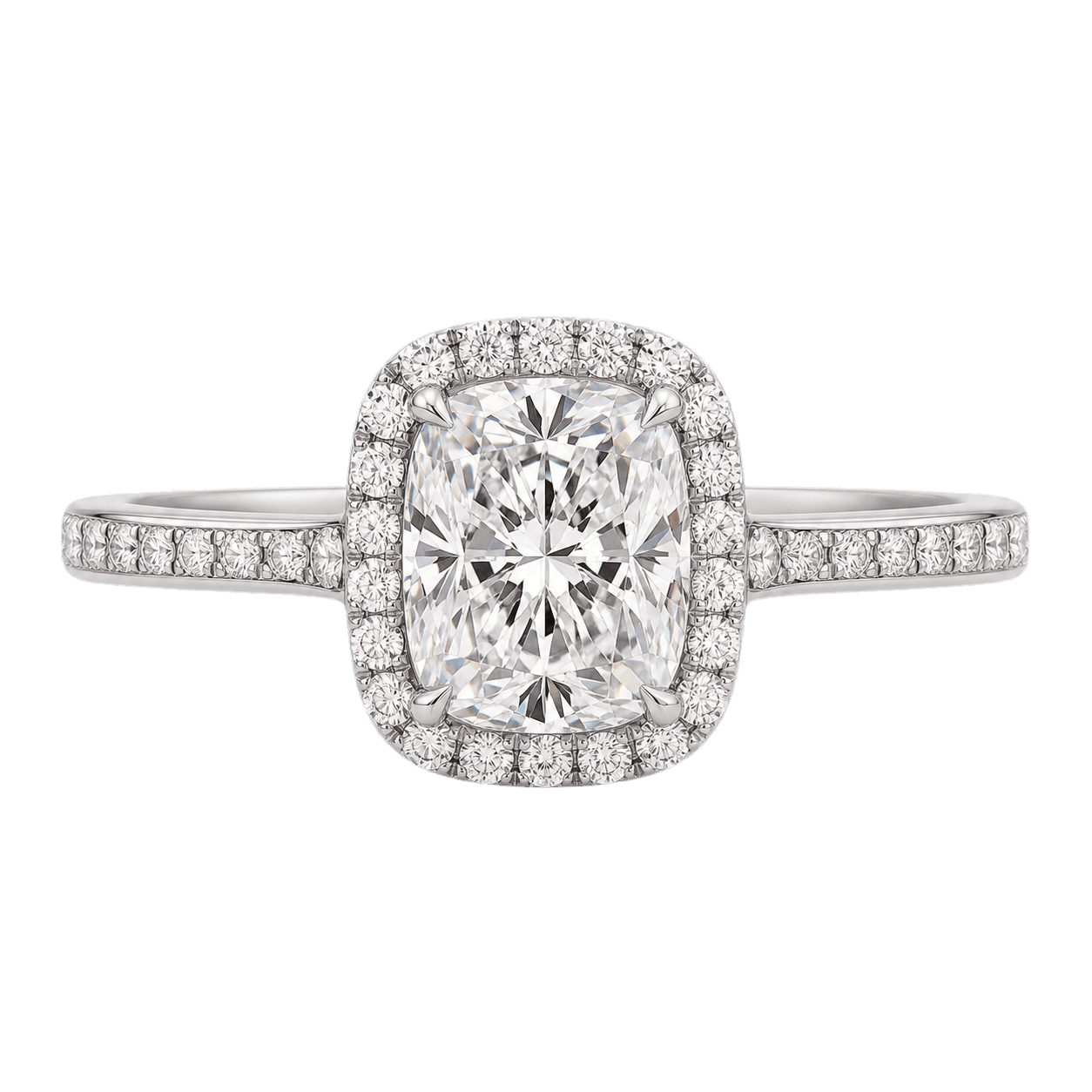
How ring sizes actually work
A ring size is just a measurement of the finger's circumference, expressed on a regional scale. The same finger can be a 6 in the United States, an L or M in the United Kingdom, and a 52 on the millimeter-based scale common across much of Europe and Asia. Half and quarter sizes exist because small differences matter: one full US size is only about 2.5 millimeters of circumference.
When you compare charts or talk to a jeweler abroad, anchor on the millimeter measurement rather than the scale label. Circumference in millimeters is unambiguous, converts cleanly between systems, and is what most sizing tools measure underneath.
United States and Canada
Numeric sizes, usually 3 to 13.5 with half sizes. Most engagement rings for women are sold between 4.5 and 7.5.
United Kingdom and Australia
Letter sizes from about F to Z. Jewelers convert to and from US sizes routinely, so a US estimate still works.
Millimeter-based scales
Common across Europe and Asia, the size number is the inner circumference in millimeters, such as 49 or 52.
Ring size chart
Ring size conversion chart: US, UK, EU and Japan
Every system below describes the same physical thing: the inside circumference of the ring. Find the measurement you have, read across the row, and give the jeweler the millimeter figure alongside the local size so nothing is lost in conversion.
| US / Canada | UK / Australia | EU / ISO (circumference, mm) | Japan / Korea | Inside diameter (mm) |
|---|---|---|---|---|
| 3 | F½ | 44.2 | 4 | 14.1 |
| 3.5 | G½ | 45.5 | 5 | 14.5 |
| 4 | H½ | 46.8 | 7 | 14.9 |
| 4.5 | I½ | 48.0 | 8 | 15.3 |
| 5 | J½ | 49.3 | 9 | 15.7 |
| 5.5 | K½ | 50.6 | 10 | 16.1 |
| 6 | L½ | 51.9 | 12 | 16.5 |
| 6.5 | M½ | 53.1 | 13 | 16.9 |
| 7 | N½ | 54.4 | 14 | 17.3 |
| 7.5 | O½ | 55.7 | 15 | 17.7 |
| 8 | P½ | 57.0 | 16 | 18.1 |
| 8.5 | Q½ | 58.3 | 18 | 18.5 |
| 9 | R½ | 59.5 | 19 | 19.0 |
| 9.5 | S½ | 60.8 | 20 | 19.4 |
| 10 | T½ | 62.1 | 21 | 19.8 |
| 10.5 | U½ | 63.3 | 22 | 20.2 |
| 11 | V½ | 64.6 | 24 | 20.6 |
| 11.5 | W½ | 65.9 | 25 | 21.0 |
| 12 | X½ | 67.2 | 26 | 21.4 |
| 12.5 | Y½ | 68.5 | 27 | 21.8 |
| 13 | Z½ | 69.7 | 29 | 22.2 |
US jewelers quote numeric sizes with half and quarter steps; the EU/ISO number is simply the circumference in millimeters, which is why it converts so cleanly.
Convert a measurement to a ring size
Measure a ring that already fits the right finger, or the finger itself, and enter the number in millimeters.
How to measure at home
- Use a ring they already wear on the target finger. Measure its inside diameter edge to edge with a ruler, or trace the inside edge on paper and measure that circle.
- If you only have the finger, wrap a thin strip of paper snugly around its base at the end of the day, mark where it overlaps, and measure that length in millimeters: that is the circumference.
- Check the knuckle. If it is noticeably larger than the base of the finger, a jeweler can suggest a compromise size, and a plastic sizer set beats string or paper for accuracy.
Conversions are rounded to the nearest standard size, and published charts differ from each other by up to half a size. Treat the result as a close estimate, confirm it with a jeweler's sizer before buying, and check the resizing policy.
Keep it a surprise: evidence beats stealth tricks
The most reliable secret method is a ring they already wear on the target finger: the ring finger of the hand they would wear an engagement ring on. Borrow it briefly and have a jeweler measure it, trace its inside edge on paper several times, or match it to a printable sizing chart. A ring worn on a different finger or the other hand is a starting point, not an answer, because fingers differ from each other more than most people expect.
If no ring exists, recruit one trusted person. A friend or family member can try rings on with them in a shop, or already know the size from a past gift. One discreet conversation usually produces better evidence than any measuring trick performed on a sleeping person, which is both unreliable and hard to explain if it fails.
Borrow the right ring
A ring worn on the correct finger, measured by a jeweler or traced carefully, is the strongest secret evidence.
Ask one trusted person
A sibling or close friend can learn the size naturally, without the question ever reaching your partner.
When in doubt, size up
A slightly large ring stays wearable and is straightforward to size down. A too-small ring may not go on at all.
Measuring when the surprise is not the point
If your partner knows a ring is coming, skip the secrecy and measure properly. An inexpensive plastic ring sizer set, or ten minutes at any jewelry counter, gives a more trustworthy result than string or paper strips, which stretch, twist, and routinely land a half size off.
Measure at the end of the day, at a comfortable temperature, and check the fit over the knuckle as well as at the base. A good fit slides on with light resistance and comes off with a firm pull. If the knuckle is noticeably larger than the finger base, a jeweler can suggest a compromise size or fit adjustments.
Fit details that change the answer
Band shape changes how a size feels. Wide bands and stacked pairings wear tighter than thin bands at the same size, so many jewelers suggest going up a quarter to half size for a substantial band. Comfort-fit interiors, with a rounded inner edge, often feel looser than flat interiors.
Fingers also change size with temperature, salt, exercise, and time of day, sometimes by a half size. Do not chase a measurement taken on a cold morning or after a workout; aim for a normal, comfortable moment.
Plan the resize before you buy
Most solitaire-style rings in gold or platinum can be resized up or down one to two sizes by a competent jeweler. Before paying, confirm the seller's resizing policy: whether the first resize is free, how long it takes, and whether resizing affects any warranty or return window.
Some designs resist resizing: full eternity bands with stones all the way around, tension-style settings, patterned or engraved bands, and some alternative metals such as tungsten. If you are unsure of the size, avoid these designs for the proposal ring or choose a seller with a generous exchange policy.
Sources and references
For definitions, evidence, and further reading, continue with these specialist and first-party resources.
Quick answers
Frequently asked questions
What is the average engagement ring size?
Commonly cited averages are around US 6 to 6.5 for women and 9 to 10 for men, but an average is weak evidence for one specific person. Height, build, and hand shape move sizes across a wide range, so use averages only as a last resort when no better clue exists.
Is it better to buy an engagement ring too big or too small?
Slightly too big. A ring a half size large can usually be worn immediately, secured temporarily, and sized down cleanly. A ring that is too small may not fit over the knuckle at all during the proposal.
Can every ring be resized?
No. Full eternity bands, tension settings, engraved or patterned bands, and some alternative metals are difficult or impossible to resize. Rings in standard gold or platinum with a plain lower band are the most resize-friendly.